



Now Reading: Colonial Theft Didn’t End — It Changed Currency
-
01
Colonial Theft Didn’t End — It Changed Currency

From the Benin Bronzes to Western museums, discover how colonial looting shaped Africa's cultural heritage and the growing movement for restitution.
From the royal treasures of Benin to sacred objects held in Western museums, Africa’s cultural heritage continues to raise questions of ownership, historical justice and the right of communities to reclaim their ancestral memory.
The price of an African artefact can be calculated at an auction. Its cultural value, however, may be impossible to measure.
Across museums, private collections and auction houses in Europe and North America, objects created by African societies continue to circulate as works of art, historical treasures and valuable investments. Some command extraordinary prices, attracting collectors drawn to their rarity, craftsmanship and cultural significance.
Yet behind certain celebrated acquisitions lies a history that cannot be separated from colonial conquest, dispossession and the removal of cultural heritage from the communities that created it.
Many of these objects were never intended to exist as commodities.
They were created to honour ancestors, communicate political authority, sustain spiritual practices, preserve collective memory and maintain relationships between generations.
Their journeys into international collections often began not with voluntary exchange, but with military expeditions, coercive acquisition and the unequal power relations of colonial rule.
Today, the growing movement for the restitution of African cultural heritage is forcing museums, governments and collectors to confront a question that has long remained unresolved: Can an object be legitimately traded when its journey into the market began with dispossession?
When Sacred Objects Became Market Commodities
The transformation of African cultural objects into internationally traded art was closely connected to European colonial expansion.
During the nineteenth and twentieth centuries, military expeditions, colonial administrators, missionaries, merchants and collectors acquired large quantities of African cultural material through widely differing circumstances.
Some objects were purchased or exchanged. Others were removed during armed conflict, seized from royal institutions or acquired under conditions in which communities had little power to refuse.
Once transported to Europe, many entered ethnographic museums and private collections, where they were classified, catalogued and displayed through systems of interpretation largely controlled by outsiders.
Objects that had once occupied specific roles within African political, religious and social institutions were increasingly presented as examples of artistic achievement or cultural difference.
Over time, these objects also acquired substantial financial value.
A ceremonial object could become a collector’s possession. A representation of an ancestor could become a museum acquisition. An artefact associated with political authority could be sold through an international auction.
These transformations did not necessarily preserve the original relationships between the objects and their communities.
While the art market assigns value through provenance, rarity, condition and demand, originating communities may understand value through responsibilities, relationships, histories and forms of knowledge that cannot be reduced to monetary terms.
This difference is central to contemporary debates over cultural restitution.
The Benin Bronzes: A History of Conquest, Looting and Sale
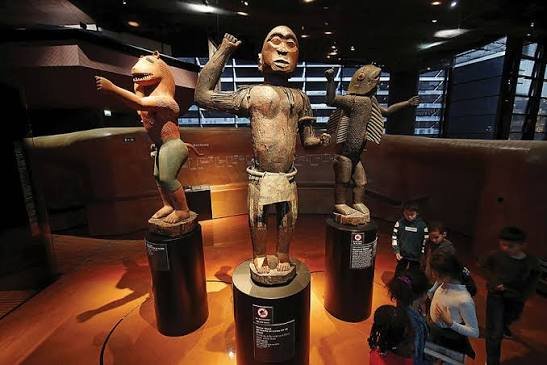
Among the most extensively documented cases of colonial cultural dispossession are the Benin Bronzes, originating from the historic Kingdom of Benin in present-day Nigeria.
In 1897, British forces invaded Benin City, looted the royal palace, removed thousands of cultural objects and exiled Oba Ovonramwen, the kingdom’s ruler.
The objects included commemorative heads, sculptural plaques, carved ivory, ceremonial regalia and other works associated with the royal court.
Some had been created to honour deceased rulers and ancestors. Others recorded aspects of political history, royal authority and the kingdom’s relationships with the wider world.
Following the invasion, large quantities of the looted material were transported abroad. Many were sold in London before entering European and North American museums and private collections. National Museum of African Art+1
The Benin Bronzes provide a particularly revealing example of how military dispossession could become incorporated into the international trade in cultural objects.
A royal collection was removed through force. Its individual objects were separated, assigned financial value and dispersed across institutions and private ownership.
Over subsequent generations, these objects became celebrated within the global history of art.
Their craftsmanship was admired, their artistic sophistication studied and their market significance established.
Yet their recognition as extraordinary works of art did not erase the circumstances of their removal.
The history of the Benin Bronzes demonstrates how the same objects can occupy two very different narratives: one concerned with artistic prestige and collecting, and another concerned with conquest, loss and the continuing struggle for cultural restitution.
The Hidden Cost of Cultural Dispossession
The removal of cultural heritage involves more than the physical displacement of objects.
For communities whose histories, ceremonies and institutions are connected to particular cultural materials, their absence can affect how knowledge is transmitted and how relationships with the past are maintained.
A royal commemorative sculpture, for example, may embody historical information about leadership, ancestry and political succession.
A ceremonial object may carry religious responsibilities or forms of knowledge that are understood fully only within its originating community.
When such objects are removed from their cultural environments, the consequences extend beyond their location.
Communities may lose opportunities to engage directly with materials associated with their own histories. Younger generations may encounter ancestral works primarily through photographs, foreign museum catalogues or exhibitions curated elsewhere.
The separation can also place control over interpretation in the hands of institutions unfamiliar with the full cultural responsibilities associated with the objects.
Cultural memory is not contained within artefacts alone. It survives through languages, oral traditions, ceremonies, community relationships and everyday practices.
Nevertheless, material heritage can play an important role in connecting these different forms of knowledge.
Restitution advocates therefore argue that returning cultural objects is not solely a matter of correcting historical ownership records. It can also contribute to restoring community access, supporting cultural transmission and recognising the authority of originating societies over their heritage.
Who Profits from Africa’s Cultural Heritage?
The commercial value of African cultural objects raises further questions about the relationship between historical dispossession and contemporary financial gain.
When an object moves through galleries, collectors and auction houses, its sale may generate income for current owners and intermediaries.
The communities from which it originated do not automatically participate in these transactions or benefit financially from them.
This distinction becomes particularly contentious when an object’s provenance reveals that it was taken through colonial military violence or other forms of coercion.
The existence of an established market does not, by itself, resolve the ethical questions surrounding an object’s acquisition.
Nor does a high auction price demonstrate that the originating community has benefited from its preservation or circulation.
Some museums and collectors argue that they have contributed to conservation, documentation and wider public access. These contributions may be significant, but they do not independently establish the legitimacy of ownership or settle claims for restitution.
The central question remains whether current possession can be justified in light of the object’s history, the circumstances of its removal and the rights of those seeking its return.
For African communities, the debate is therefore not simply about the financial value created by the art market.
It is also about who has been able to exercise control over cultural heritage, who has benefited from its circulation and who has been excluded from decisions concerning its future.
Restitution Is Beginning to Change the Conversation
After decades of advocacy by African governments, traditional authorities, scholars and cultural institutions, some European museums and governments have begun returning objects removed during the colonial period.
In June 2025, the Netherlands formally handed over 119 Benin artefacts to Nigeria, including 113 from the Dutch State Collection and six from the municipality of Rotterdam.
The Dutch government acknowledged that the objects had been looted during the British attack on Benin City in 1897. The return followed provenance research and cooperation with Nigeria’s National Commission for Museums and Monuments. Government of the Netherlands+1
Further progress followed in 2026.
On 29 June, three Swiss museums returned 18 artefacts from the Kingdom of Benin to Nigeria. The handover formed part of a broader restitution agreement and included objects associated with the kingdom’s royal and religious traditions.
The institutions involved had undertaken collaborative provenance research through the Benin Initiative Switzerland, working with Nigerian partners to investigate the objects’ histories and support decisions on their return. UZH+1
These developments demonstrate that restitution is no longer confined to theoretical discussion.
Ownership transfers, physical returns, bilateral agreements and institutional research are creating practical mechanisms through which historical claims can be addressed.
However, returning individual collections does not resolve the wider legacy of colonial acquisition.
Large numbers of African cultural objects remain in museums and private collections outside the continent, while questions of provenance, legal ownership, access and cultural authority continue to generate debate.
Beyond Ownership: Who Has the Right to Decide?
One of the most important questions in the restitution debate concerns what happens after an object is returned.
Should it enter a national museum? Should responsibility rest with a traditional authority, an originating community or another cultural institution? Who determines whether it should be displayed publicly, used ceremonially or protected from public access?
These questions cannot always be answered through national ownership alone.
African societies encompass diverse communities, political histories and cultural traditions. The relationship between a modern state and an object’s originating community may be complex.
Meaningful restitution must therefore consider not only international transfers of ownership but also the participation of those whose histories and responsibilities are connected to the heritage concerned.
In this context, cultural sovereignty involves the authority to make decisions about preservation, interpretation, access and future use.
It also involves recognising that not every object holds the same significance.
Some may be appropriate for public exhibition and academic research. Others may require particular protocols, restrictions or forms of custodianship defined by the communities to which they belong.
The future of African cultural restitution will depend partly on how effectively these different responsibilities are recognised.
The Right to Cultural Memory
For generations, African cultural objects have contributed to the prestige of institutions far from the places in which they were created.
They have become important to art history, museum collections and international scholarship.
But their global recognition has also drawn renewed attention to the circumstances under which many were removed and the continuing claims of the societies that produced them.
The movement for restitution challenges the assumption that preservation in a foreign institution is necessarily an adequate substitute for community access, cultural continuity or the right to determine an object’s future.
It also invites a different understanding of heritage.
A cultural object is not always simply evidence of a civilisation that once existed. It may remain part of a living relationship between people, ancestors, land, political institutions and collective memory.
Its significance cannot necessarily be captured through an auction estimate or a museum label.
The question confronting the international art world is therefore larger than whether particular objects should be returned.
It concerns whether the systems through which cultural heritage is owned, valued and interpreted can acknowledge the historical inequalities that helped establish them.
Colonial rule may have formally ended across much of Africa, but its effects remain visible in the distribution of cultural collections and in the institutions that continue to control them.
Restitution offers one means of addressing that inheritance.
It cannot reverse every consequence of colonial dispossession. But it can restore access to cultural materials, recognise historical injustices and allow originating communities and institutions a greater role in determining the future of their heritage.
The return of an ancestral object is not simply the movement of an artefact from one collection to another. It can also be the restoration of a community’s authority to tell, preserve and carry forward its own history.rike has affected reality TV’s ecosystem in ways that weren’t as pronounced during the 2007 strike, leaving the genre exposed.
Stay Informed With the Latest & Most Important News
Previous Post
Next Post


Advertisement