




Now Reading: Australia Launches Indigenous Design Institute to Place First Nations Knowledge at the Centre of Design
-
01
Australia Launches Indigenous Design Institute to Place First Nations Knowledge at the Centre of Design
Australia Launches Indigenous Design Institute to Place First Nations Knowledge at the Centre of Design

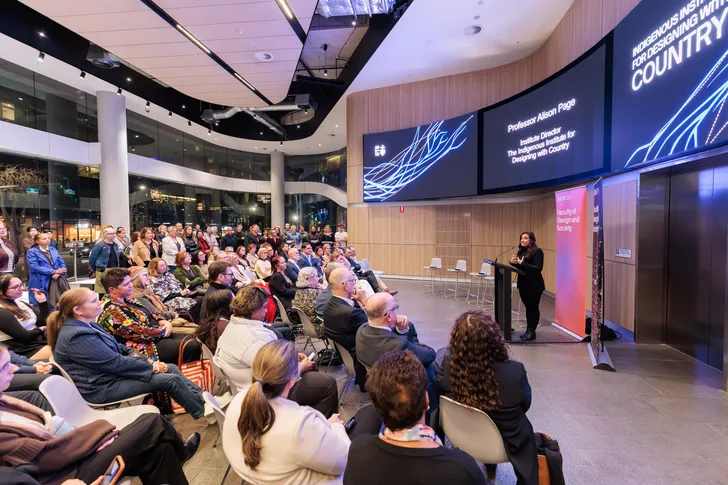
Led by Aboriginal designers and cultural practitioners, the new institute at the University of Technology Sydney seeks to reshape how architecture, education and the built environment respond to land, culture and community.
Sydney, Australia | July 2026
What happens when design begins not with a building, a product or a technological solution, but with the land itself and the generations of knowledge embedded within it?
This question lies at the heart of a new Indigenous-led design institute launched by the University of Technology Sydney (UTS), bringing First Nations knowledge systems into contemporary conversations about architecture, urban development, sustainability and design education.
Officially inaugurated on 27 July 2026, the Indigenous Institute for Designing with Country (IIDwC) has been established as a cross-disciplinary centre for research, teaching and collaboration between Indigenous communities, designers, academics and industry professionals.
The university describes the initiative as a world-leading laboratory for Country-centred design thinking, drawing upon tens of thousands of years of Aboriginal cultural knowledge and innovation.
Rather than treating Indigenous knowledge as an additional perspective within established design practices, the institute seeks to make it foundational to how places, systems and environments are imagined and created. UTS+1
Designing with Country: A Different Way of Understanding Design
At the centre of the institute’s philosophy is the Aboriginal concept of Country, which extends beyond the physical understanding of land as geography or property.
In many Aboriginal worldviews, Country encompasses relationships between people, ancestral histories, plants, animals, waterways, ecological systems and cultural responsibilities.
Designing with Country therefore asks architects, planners and designers to consider not only what can be built in a particular place, but also the relationships, histories and responsibilities that already exist there.
The approach challenges conventional development models that frequently begin by viewing land primarily as a site for construction or economic activity.
For Professor Alison Page, the institute’s founding director, this shift involves reconsidering the fundamental assumptions that guide contemporary design.
Page, an Aboriginal designer and descendant of the Dharawal and Yuin peoples, describes Designing with Country as a framework for rethinking the design of society itself.
Her approach recognises land as a living system of knowledge and relationships, offering alternative ways to respond to climate change, expanding cities and the wellbeing of communities.
The underlying proposition is that Indigenous knowledge is not simply a record of the past. It is a living body of intellectual, ecological and cultural practice capable of informing contemporary design decisions. Alison Page+1
First Nations Designers Leading the Conversation
The institute brings together Aboriginal creative practitioners whose work spans architecture, cultural storytelling, curatorial practice and the built environment.
Professor Alison Page leads the institute alongside prominent First Nations practitioners, including architect Dr Dillon Kombumerri, a Yugambeh man, and curator Professor Emily McDaniel, a Wiradjuri woman.
Their involvement reflects an approach in which Indigenous practitioners lead the interpretation and application of their own cultural knowledge within professional and academic institutions.
Kombumerri has emphasised the need for a fundamental change in how societies design and manage the environments they inhabit, linking the initiative to the broader responsibility of restoring ecological health and building a sustainable future.
The institute’s interdisciplinary structure also recognises that the challenges facing contemporary societies cannot be addressed through architecture or design alone.
Questions of land management, ecological restoration, cultural heritage, public infrastructure and community wellbeing require collaboration between different fields of knowledge.
By connecting these disciplines, the institute aims to create opportunities for Indigenous ways of knowing to influence the decisions that shape everyday environments. UTS+1
Opening New Pathways for Aboriginal and Torres Strait Islander Students
Alongside research and professional collaboration, education forms a central part of the institute’s mandate.
The initiative is intended to provide learning opportunities through undergraduate and postgraduate education, professional development programmes and shorter courses, including micro-credentials.
A major priority is increasing Aboriginal and Torres Strait Islander participation in design-related professions, where Indigenous representation has historically been limited.
For Page, this is not only a question of access to educational institutions. It is also about recognising the cultural and ecological understanding that Indigenous students bring into creative and technical disciplines.
The institute seeks to develop an educational environment where First Nations students can engage with contemporary design methods while remaining connected to their cultural knowledge systems.
Such an approach also creates possibilities for rethinking design curricula themselves.
Rather than positioning Indigenous knowledge solely as material to be studied, the institute envisions it as a source of methods, principles and practices through which design can be taught.
Page has also described Indigenous storytelling and Songlines as important foundations for understanding how cultural, ecological and social knowledge can be carried through place.
The ambition is to support a new generation of designers who can move between Indigenous and contemporary professional knowledge systems without treating them as mutually exclusive. Alison Page+1
Bringing Indigenous Knowledge into Architecture and Industry
The influence of Designing with Country is intended to extend beyond university classrooms.
The institute aims to work with architects, planners, land management professionals, cultural practitioners, government agencies and private industry to explore how Country-centred approaches can shape real-world projects.
Professor Robynne Quiggin, UTS Pro-Vice-Chancellor for Indigenous Leadership and Engagement, has described the institute as a meeting point for education, research, industry and community relationships.
These collaborations could influence the design of public spaces, urban infrastructure, buildings and other environments by encouraging practitioners to engage more deeply with the cultural and ecological characteristics of place.
The institute has also begun establishing industry relationships, with Australian property and infrastructure group Lendlease announced as an inaugural partner.
Such partnerships create an opportunity to test how Indigenous design principles can be incorporated into large-scale development, although their longer-term impact will depend on how community participation and decision-making are implemented in practice. UTS+1
A Wider Conversation About Indigenous Futures
The establishment of the Indigenous Institute for Designing with Country arrives at a time when architecture, urban planning and design institutions internationally are confronting questions about sustainability, cultural representation and the consequences of development.
For Indigenous communities, these conversations also involve deeper questions about authority over land, cultural knowledge and the environments in which future generations will live.
The institute’s significance therefore extends beyond the creation of another academic research centre.
It represents an institutional effort to recognise Indigenous peoples as designers, educators, researchers and knowledge holders whose intellectual traditions can shape the future of entire industries.
Its ambitions also invite an important question: what would the world’s cities, public spaces and educational systems look like if Indigenous knowledge were considered from the beginning of the design process, rather than introduced after major decisions had already been made?
The answer will depend on how institutions translate such commitments into meaningful changes in education, research, professional practice and community relationships.
For now, the institute’s launch signals a shift in the conversation about Indigenous participation in design.
The future of design may not require moving away from ancestral knowledge, but learning how to design with it.
Source : Architecture, Au
Related Posts


Stay Informed With the Latest & Most Important News
Previous Post
Next Post


Advertisement